
Top 6 Things DoD Contractors Need to Know About CMMC — November 2025
Summary
TL;DR:
- CMMC 2.0 is now in effect for DoD contracts. As of November 2025, defense contractors must demonstrate cybersecurity compliance to remain eligible for new U.S. Department of Defense solicitations.
- Level 1 compliance is the starting point—but not “easy.” It covers 17 basic safeguarding practices for Federal Contract Information (FCI) such as secure passwords, patching, access control, and employee awareness; MFA is recommended but becomes mandatory at Level 2.
- Level 1 requires a documented annual self-assessment. Contractors must review controls, score their implementation, and upload results to SPRS with proof—this is not a simple checkbox exercise.
- People and processes matter as much as technology. Ongoing employee training, phishing simulations, incident-response planning, vulnerability scans, and asset inventories are essential to maintain compliance.
- Early preparation creates business advantages beyond compliance. Building a strong Level 1 foundation reduces future Level 2 certification costs, improves cyber resilience, increases subcontracting opportunities, and strengthens trust with partners and insurers.
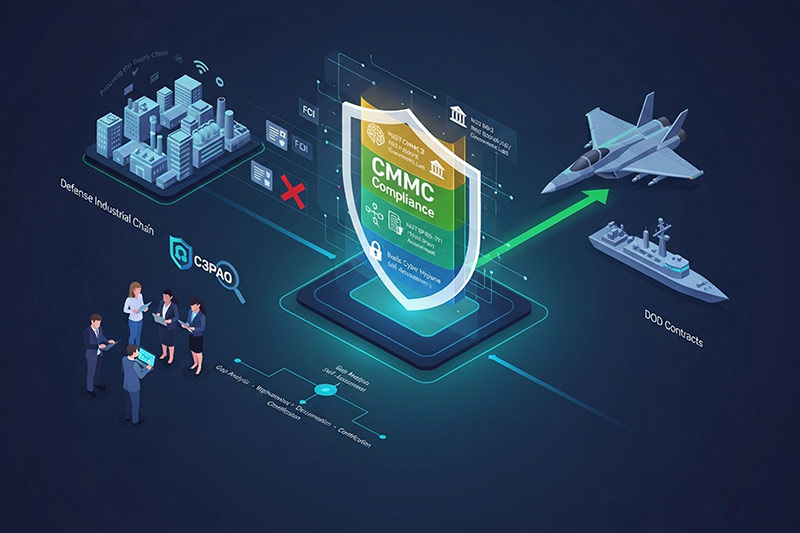
As of November 10, 2025, the U.S. Department of Defense’s Cybersecurity Maturity Model Certification (CMMC 2.0) is officially in effect. That means defense contractors—large and small—must now demonstrate compliance to remain eligible for new DoD contracts.
The framework can feel complex and intimidating, but understanding what’s required (and what isn’t) is the first step toward compliance—and continued business.
Here are the six things every DoD contractor needs to know about CMMC right now.
1. CMMC 2.0 Is Now Live—and the First Phase Has Begun
The DoD’s CMMC 2.0 rule became effective November 10, 2025, marking the start of its phased rollout. Contracting officers can now include CMMC requirements in new solicitations, beginning with Level 1 self-assessments for companies handling Federal Contract Information (FCI).
CMMC 2.0 establishes a clear, tiered structure to safeguard sensitive defense data. See table.
If your organization manufactures components, provides parts, or supports DoD programs, Level 1 compliance is likely your starting point.
The DoD calls CMMC “a comprehensive framework to protect the defense industrial base’s sensitive unclassified information from increasingly frequent and complex cyberattacks.”

2. Level 1 Compliance Is the Foundation—But Don’t Confuse It with Easy
Level 1 focuses on essential safeguards that protect FCI, such as secure passwords, software updates, device access control, and employee awareness training. It’s a strong baseline—but not a light lift.
One common misconception: multi-factor authentication (MFA) is recommended but not required under Level 1. MFA becomes mandatory at Level 2, which applies to contractors handling Controlled Unclassified Information (CUI).
Still, adding MFA now is a smart investment. It strengthens your security posture, protects login credentials, and positions your organization for future readiness.
Even these 17 basic practices can be challenging to document and maintain. A 2023 survey found that only 4 percent of contractors passed third-party CMMC evaluations—despite 75 percent believing they were compliant. The lesson: don’t assume; assess.
3. What “Self-Assessment” Actually Means Under Level 1
Unlike Levels 2 and 3, Level 1 does not require a third-party or government-led audit. Instead, organizations perform an annual self-assessment against the 17 FAR 52.204-21 safeguarding requirements that form the basis of Level 1.
You’ll need to:
- Review each of the 17 controls (covering access control, identification and authentication, incident response, and more).
- Score your organization’s implementation using the DoD’s self-assessment methodology.
- Upload your results and affirmation to the Supplier Performance Risk System (SPRS).
Levels 2 and 3, by contrast, require independent third-party certification or government assessment depending on the sensitivity of the information handled.
This isn’t a “check-the-box” exercise—the DoD expects contractors to provide proof of each control. If your self-assessment is inaccurate or unsupported, you could lose eligibility for future contracts. That’s why many small manufacturers turn to partners like SensCy for structured guidance and documentation support.
4. Cybersecurity Is About People and Processes—Not Just Technology
Technology alone can’t achieve compliance. Many CMMC requirements depend on consistent behavior, clear policies, and ongoing awareness.
To maintain compliance, your organization should:
- Deliver annual cybersecurity training for employees.
- Conduct phishing simulations and incident-response exercises.
- Maintain up-to-date policies and procedures.
- Run vulnerability scans and track remediation.
- Keep an accurate asset inventory and monitor access.
SensCy helps small and mid-sized manufacturers implement these controls through a human-first approach—pairing you with a dedicated Cyber Risk Advocate who walks you through every step.
5. CMMC Compliance Strengthens Your Business Beyond DoD Contracts
While CMMC is a federal mandate, it’s also a competitive advantage. Demonstrating compliance shows your company takes cybersecurity seriously—building trust with prime contractors, supply-chain partners, and insurers.
Benefits include:
- Greater eligibility for subcontracting opportunities
- Lower cyber-insurance costs
- Fewer disruptions from cyber incidents
- Enhanced credibility and customer confidence
Simply put: compliance isn’t just about defense—it’s about resilience and growth.
6. Starting with Level 1 Saves Time, Money, and Stress
Preparing for CMMC Level 2 certification can cost an estimated $40,000 to $100,000+, depending on size and scope. Building a strong Level 1 foundation now helps you:
- Reduce long-term certification costs
- Identify gaps early
- Avoid disqualification from new contracts
- Strengthen your overall security posture
That’s where SensCy’s Sensible Cyber Solution makes the difference. We simplify CMMC compliance for small manufacturers by offering:
- Policy creation and annual updates
- Awareness training and phishing simulations
- Risk assessments, vulnerability scans, and remediation tracking
- Continuous support from a dedicated Cyber Risk Advocate
Your Next Step: Get CMMC Ready with SensCy
CMMC 2.0 is live—and it’s here to stay. Whether you’re navigating your first self-assessment or strengthening your cybersecurity program, SensCy helps make compliance achievable and affordable.
Our CMMC readiness program helps you:
- Achieve and maintain Level 1 compliance
- Reduce the cost and complexity of CMMC Level 2 certification preparation
- Build a culture of security that protects your business and your contracts
Assess your Level 1 readiness today by completing our no-obligation cyber assessment. With your SensCy Score®, you can approach compliance with confidence.
👉 To get started, schedule a SensCy Score® assessment today.
The SensCy Solution
We provide an affordable, easy-to-understand, sensible solution specifically tailored to each client. Our clients tell us that they are thrilled with the value that they derive for the price they pay. Schedule a consultation with one of our experts.

Your SensCy Score® is a good indication of your organization’s cyber hygiene and how prepared your organization is against cyber threats. We can generate your score in less than 30 minutes—at no cost to you!
Recent Posts

